
How Is It That You Have No Faith? | What Biblical Faith Really Means
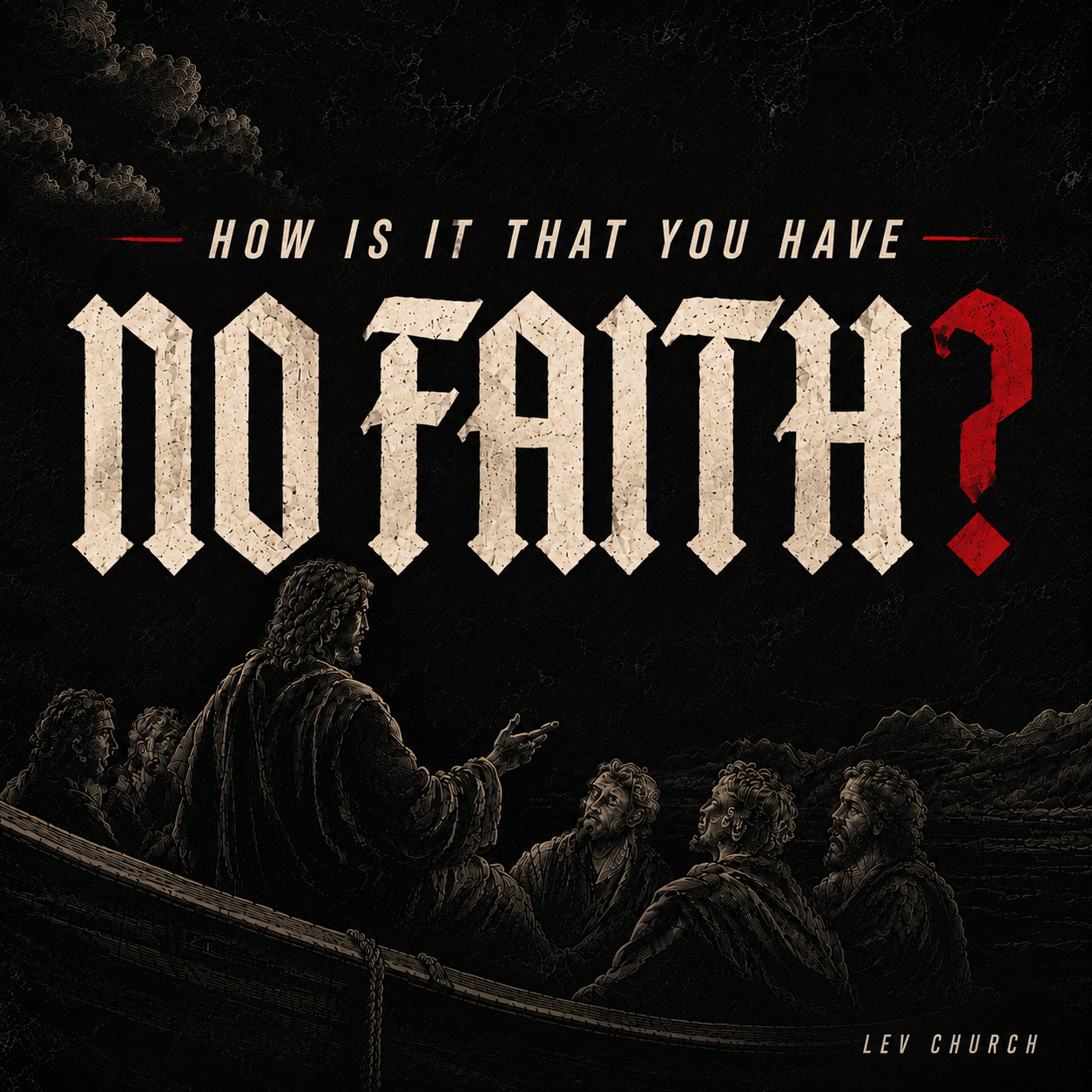
Faith is one of those words that can become so familiar that we stop asking what it actually means.
We talk about faith. We sing about faith. We tell people to have faith. We describe ourselves as people of faith and say that we are walking by faith. When life becomes difficult, one of the most common Christian responses is simply, “Have faith.”
But familiarity with a word does not necessarily mean we understand it biblically.
Scripture gives faith enormous importance. We are saved through faith. We are called to live by faith and walk by faith. Jesus commends faith, marvels at faith, responds to faith, and at times confronts its absence. Scripture speaks about great faith, little faith, growing faith, faith that works, faith that perseveres, and even faith without works that James says is dead.
So the question matters: What does the Bible actually mean by faith?
An even more uncomfortable question follows. Is it possible to genuinely know God, love Him, follow Jesus, have a history with Him, experience His faithfulness firsthand, and still have areas of life where faith is not present?
Mark 4 suggests that the answer is yes.
Jesus and His disciples are crossing the Sea of Galilee when a violent storm overtakes them. The waves are beating into the boat, water is coming in, and Jesus is asleep in the stern. His disciples wake Him with a question:
“Teacher, do You not care that we are perishing?”
Jesus rises, rebukes the wind, and speaks to the sea: “Peace, be still!” The wind ceases and the sea becomes calm.
Then He turns to His disciples and asks:
“Why are you so fearful? How is it that you have no faith?”
— Mark 4:40 NKJV
What makes Jesus' question so striking is not simply what He asks, but who He asks.
These are not men who have never trusted Him.
By this point in Mark's Gospel, Peter, Andrew, James, and John have already left their livelihoods to follow Jesus. They have heard Him teach with authority. They have watched Him cast out demons. Peter has seen Jesus heal his mother-in-law. They have watched healings happen again and again. They have followed Jesus closely enough to receive explanations of the kingdom that others did not receive.
Their lives already contain evidence of trust.
They dropped their nets. They left what was familiar. They followed Him into an unknown future.
Yet in the middle of this storm Jesus looks at these same men and asks, “How is it that you have no faith?”
Apparently, trusting God in one place does not automatically mean that we are trusting Him everywhere.
We can have trusted Him there and still discover a here where we are struggling to trust Him.
We can have genuine history with God, real testimonies of His faithfulness, years of following Him, and still encounter a circumstance that exposes an area where our trust has not yet caught up with what He has revealed about Himself.
That is exactly what the storm exposes in the disciples.
Their first response is revealing. They do not simply wake Jesus and say that there is a storm. They do not merely ask Him for help. Their question is, “Do You not care?”
The storm has begun to tell them something about Jesus.
If He cared, would He be sleeping?
If He cared, would they be in this situation?
If He cared, wouldn't He have done something already?
The storm is no longer simply shaping their understanding of their circumstances. It is beginning to shape their understanding of His character.
That struggle is as old as humanity.
In Genesis 3, the serpent's strategy is not primarily to convince Eve that God does not exist. Instead, he introduces doubt about the character of the God she already knows. Is God telling the truth? Is He really good? Is He withholding something from you?
Different circumstances produce different questions, but underneath them is the same ancient issue:
Can God really be trusted?
That question takes us to the heart of biblical faith, because faith does not begin with how strongly we can convince ourselves to believe something. Faith begins with the character of the One we are being asked to trust.
Throughout Scripture, men and women entrusted their families, futures, possessions, reputations, and even their lives to God. They did not do this because they possessed some extraordinary internal ability to believe. They did it because they came to know something about Him.
He is faithful.
That connection becomes especially clear in the language of Scripture.
One of the important Hebrew word families associated with faith comes from the root represented by the letters ʾ-M-N. From this family come ideas connected with firmness, reliability, faithfulness, being established, and believing. Even the familiar word amen belongs to this family.
The ideas are connected. Something that is firm can be relied upon. Someone who is faithful can be trusted. When we become aware of that faithfulness, we can entrust ourselves to the one who is faithful.
Deuteronomy 7:9 describes God this way:
“Therefore know that the LORD your God, He is God, the faithful God...”
God does not become faithful when we trust Him.
He does not become faithful when we understand Him.
He does not become faithful when circumstances turn out the way we hoped.
He is the faithful God.
His faithfulness exists before our faith ever responds to it. Our faith does not make Him trustworthy. His trustworthiness is what makes faith possible.
Abraham demonstrates this clearly.
God had promised Abraham descendants, yet everything visible around him seemed to move farther and farther from the fulfillment of that promise. Abraham was growing older. Sarah was growing older. They still had no son.
In Genesis 15, God takes Abraham outside and tells him to look at the stars.
“So shall your descendants be.”
Then Scripture says:
“And he believed in the LORD...”
The direction of Abraham's faith matters.
He believed in the Lord.
Abraham is not being called to believe in himself. He is not being asked to pretend his circumstances are different than they are. He is not being asked to manufacture confidence through sheer determination.
God has revealed Himself and spoken, and Abraham responds to Him.
Faith does not originate in Abraham's ability to believe. It originates in a God who has revealed Himself as worthy of Abraham's trust.
The same pattern continues in the New Testament.
The Greek word commonly translated “faith” is pistis, while the related verb pisteuō is commonly translated “believe” or “trust.” Our English translations can sometimes make faith and believing sound like separate ideas, but they belong to the same family of thought.
Biblical faith always has an object.
It is not enough to say, “I believe.”
The more important questions are: Who are you believing? Who are you trusting? Who are you entrusting yourself to?
Hebrews 11:11 gives us a beautiful picture of this in Sarah:
“By faith Sarah herself also received strength to conceive seed, and she bore a child when she was past the age, because she judged Him faithful who had promised.”
Her attention is not ultimately fixed on the promise by itself.
It is fixed on Him.
She judged Him faithful who had promised.
Her faith did not make God faithful. He was already faithful. Her response did not make His promise true. He had already spoken. But her response to His faithfulness still mattered.
Hebrews 10:23 makes the same connection:
“Let us hold fast the confession of our hope without wavering, for He who promised is faithful.”
Why can we hold fast?
Because He who promised is faithful.
Our faith rests on His faithfulness.
That gives us a helpful way of describing biblical faith:
Biblical faith is a relational response to the character and revelation of God, whereby we become aware that He is faithful and entrust ourselves to Him.
Or more simply:
We become aware that He is faithful and entrust ourselves to Him.
With that definition in mind, the disciples' struggle in the boat becomes even clearer.
They had already become aware of many things about Jesus. They had heard Him. They had watched Him. They had followed Him. They had entrusted significant portions of their lives to Him.
But in this particular moment, what Jesus had already revealed about Himself was not governing their response.
There is another detail in the story that is easy to overlook.
Peter, Andrew, James, and John were fishermen.
They knew boats. They knew the water. They knew the wind. They knew what it meant when waves began coming over the side of a boat. Of all the environments in which they might have felt confident in their own understanding, this was one of them.
Their experience was not wrong. The storm was real. The boat was filling. They understood enough to know that the situation was dangerous.
The problem was not that they knew too much about boats.
The problem was that what they knew about boats began to carry more weight than what they were learning about Jesus.
That is where experience can become dangerous.
Experience itself is not the enemy. Wisdom is not the enemy. Knowledge is not the enemy. Expertise is not the enemy. The problem comes when what we know becomes the thing we trust more than the One we know.
There is a difference between having experience and trusting in our experience. There is a difference between possessing wisdom and trusting in our wisdom. There is a difference between having resources and trusting in our resources.
We may never consciously say, “I don't trust God.”
Instead, we say things like, “I know how this works.”
I know what normally happens next.
I know what the numbers say.
I know what the doctor said.
I have been here before.
I have dealt with this before.
None of those things are necessarily wrong. Circumstances can give us real information. Experience can teach us valuable things.
But circumstances and experience have limits.
Circumstances are very good at telling us what is happening around us. They are terrible at telling us who God is.
The storm could tell the disciples that the boat was filling. Their experience could tell them that they were in danger.
But neither the storm nor their experience had the authority to define the character of Jesus.
Yet that is exactly what was beginning to happen when they asked, “Do You not care?”
Their circumstances had moved beyond describing the situation and had begun interpreting God.
Scripture repeatedly warns us about that mistake.
The Israelites encountered something similar at the Red Sea. They had cried out for deliverance from Egypt and watched God answer them in extraordinary ways. They saw plague after plague. They watched God distinguish between Egypt and His people. They watched Pharaoh finally release them.
Then they arrived at the Red Sea.
Water was in front of them, and Pharaoh's army was behind them.
Their circumstances suddenly seemed to contradict everything they had just experienced of God's deliverance, and they cried:
“Because there were no graves in Egypt, have you taken us away to die in the wilderness?”
After everything God had done, their circumstances caused them to ask whether He had brought them there to kill them.
Centuries later, Jesus' disciples experience essentially the same struggle.
They have watched Him heal. They have watched Him cast out demons. They have heard His teaching. They have left everything to follow Him. Jesus Himself told them, “Let us cross over to the other side.”
Then the storm came.
“Do You not care that we are perishing?”
Different people. Different circumstances. The same underlying question:
After everything I have seen You do, can I trust You here?
There is another important similarity between those stories.
Israel did not arrive at the Red Sea because they had stopped following God.
God led them there.
The disciples did not enter the storm because they were running from Jesus.
They were in the boat because they were following Jesus.
That means a difficult place is not automatically evidence that we have wandered outside the will of God. Sometimes the very place where our faith is exposed is part of the way God is discipling us.
Discipleship is more than learning information about God. Eventually, what has been revealed to us about Him has to meet a situation in which we actually have the opportunity to entrust ourselves to Him.
Sometimes those moments reveal growth. We discover that we have learned to trust Him in a place where we once struggled.
Other times they reveal that there is still more to learn.
That is not necessarily condemnation.
It is discipleship.
Jesus does not throw the disciples out of the boat when their lack of faith is exposed. He does not invalidate their decision to follow Him or dismiss everything they have already experienced.
He addresses the place where growth still needs to happen.
If we are going to grow in faith, we have to be willing to let the Holy Spirit do the same thing in us. We have to be willing for Him to reveal the areas where we are still trusting ourselves, where circumstances have been defining God's character for us, or where we have trusted Him in the past but are struggling to entrust ourselves to Him now.
The goal is not shame.
The goal is to know Him more.
That is exactly what happens to the disciples after Jesus calms the storm.
Mark 4:41 says:
“And they feared exceedingly, and said to one another, ‘Who can this be, that even the wind and the sea obey Him!’”
That question is remarkable.
“Who can this be?”
These men already know Jesus, yet they are still discovering Him.
They entered the boat knowing the Jesus who taught with authority, healed sickness, and cast out demons. They came through the storm having discovered something else about Him.
Even the wind and sea obey Him.
The storm exposed an area where their faith needed to grow, but it also became a place where their awareness of Jesus grew.
They knew more about Him on the other side of the storm than they did when they entered it.
That matters because faith grows in relationship to revelation. What they have now seen of Jesus becomes part of what they can entrust themselves to the next time.
There is also an interesting shift in the way Mark describes their fear.
Jesus asks them, “Why are you so fearful?” Yet immediately after the storm is calmed, Mark says, “they feared exceedingly.”
At first that almost sounds contradictory.
But the object of their fear has changed.
Before Jesus speaks, they are overwhelmed by what the storm can do.
After Jesus speaks, they are overwhelmed by who Jesus is.
The wind is gone. The waves are calm. The immediate danger has disappeared. Yet suddenly they are confronted with the reality of who has been sitting in the boat with them all along.
They entered the storm overwhelmed by what the sea could do.
They came out overwhelmed by the One the sea obeyed.
That is where Jesus' question becomes personal.
How is it that you have no faith?
Not as an accusation hurled from a distance, but as a question from the One who is still discipling us.
Where is the place in your life where you have trusted God there, but are struggling to trust Him here?
Perhaps it is your finances. Your health. Your children. Your marriage. Your future. Maybe it is actually an area where you are highly capable and experienced, where you have spent years saying, “I know how this works.”
The answer is not to manufacture stronger feelings of belief.
Faith does not begin with our ability to believe harder.
It begins by turning our attention back to the One we are being asked to trust.
What has God revealed about Himself?
What has He said?
What do we know to be true about His character?
Where have we already seen His faithfulness?
And where there are things about Him we do not yet understand, perhaps the prayer is simply:
Jesus, reveal Yourself to me here.
Show me where I have allowed my circumstances, my experience, or my own understanding to tell me something about You that You have never said about Yourself.
Help me know You rightly.
And then help me entrust this place to You.
Because that is faith.
We become aware that He is faithful and entrust ourselves to Him.
We do not need to make God faithful.
He already is.
We do not need to convince Him to become trustworthy.
He already is.
He has always been faithful, and He will always be faithful.
And because He is faithful, we can entrust ourselves to Him.